Obama promised to expand the financial support government provides for the training of health care personnel. In the big stimulus bill, he did so to the tune of $500 million. Promise kept.
I am completely unfamiliar with any political issue surrounding this promise or it's fulfillment. Were health care personnel previously under-trained? Did they need that money? Was it enough? Was it too much? Is there any mechanism in place to make sure it's going to the right people and making a difference? It seems to come completely out of the blue.
It's one of the approximately 140 independent items passed as one huge, joint program above and beyond the usual government spending budget in the huge omnibus American Recovery and Reinvestment Act of 2009, unofficially called the Stimulus Bill. One criticism of the big stimulus bill is that you could hide entire programs in the bill and no one would even find and address them before they became law. No oversight. No debate.
I'd say this is a perfect example. It sounds good, sure. Who wants untrained medical personnel? I suppose it's part of a greater emphasis on health in America, but I wasn't aware of any major lack of training problem in the medical field or that this spending has or will actually improve American health. Wikipedia has 6 words on the topic. Google News has seemingly no related search results. Have you heard anything about it? Has there been any debate, consideration, or discussion of this point at all?
I guess it was slipped in completely under the radar. I wonder what else passed that no one noticed.
Showing posts with label stimulus. Show all posts
Showing posts with label stimulus. Show all posts
Wednesday, September 23, 2009

Friday, September 11, 2009
Obameter #40: Fixing The Alternative Minimum Tax
(WTC: Remember and Rebuild.)
In 1984, Secretary of the Treasury Donald Regan asked President Ronald Reagan what General Electric, Boeing, General Dynamics, and more than 50 other big companies had in common. Reagan replied that he didn't know. Regan told him that they pay no taxes at all, and provided proof. Both men agreed this was wrong. In the 1984 State of the Union address, Reagan announced his intention "to simplify the entire tax code so all taxpayers, big and small, are treated fairly."
In 1986, the Reagan Administration along with allied Democrats from the Legislature passed the Tax Reform Act of 1986, which lowered tax rates while closing numerous tax loopholes and simplifying the tax rules. It also set an Alternative Minimum Tax, insuring that rich companies and individuals could not escape paying a certain level of taxes no matter how creative their use of tax shelters and tax write-offs.
However, unlike the standard tax brackets, the requirements of the alternative minimum tax were not bound to inflation. As the value of the dollar shrinks over time, more and more of the middle class began to fall under the definition of "rich" used by the alternative minimum tax. Legislatures have frequently passed AMT "patches" to exempt the middle class from the tax for a year or so, but a permanent fix was considered too expensive to the annual budget.
During the 2008 campaign, Obama and McCain both promised to make the 2007 patch permanent and index the AMT to inflation, thus preventing it from gradually covering individuals with lower and lower income levels. The permanent fix was added by the Senate to the The American Recovery and Reinvestment Act of 2009 (the Stimulus Bill) in negotiations with Senate Republicans whose votes were needed to pass the overall bill. Three Republican Senators, Susan Collins of Maine, Olympia Snowe of Maine, and Arlen Specter of Pennsylvania, were convinced by these negotiations and the ARRA passed. They are the only Republicans in the House or the Senate to vote for the ARRA package.
 For Obama, that means promise kept. For Republicans, it's a depressing sign of how little influence we have in government today; even with 92% of Republicans in the Senate and 99.4% in the House opposing the ARRA, it still passed. I don't know what else was involved in those Senate negotiations, but I hope one universally supported issue point was not the purchase price of three Republican Senators' support for such a ridiculously huge chuck of government spending as the ARRA ($787 billion).
I do support the AMT changes as promised and delivered, so thumbs up for Obama on that point. The massive stimulus bill of which it was an influential part has earned my disgust and opposition. Since it is far too complex and inclusive to ever be covered as an Obama promise separately, I'm going to take this time to rant in address of the ARRA itself directly.
There are parts of ARRA I like and parts I don't like. Virtually anyone would be able to say the same thing. It has hundreds of individual programs all passed together as one incredible, huge, diverse behemoth measuring three quarters of a trillion dollars. It's five times the cost of the Bush Administration's stimulus bill of 2008, and twice the size of all the Homeland Security Appropriations Acts of that administration combined (at the time, Democrats in the House condemned the Homeland Security Act for changing too much with one monolithic bill), and it's larger than the entire US Federal Budget of 1982. It contains more than 140 separate programs that could not be addressed individually, but only confirmed or rejected as a massive whole. It's complexity ensures that everyone who voted for it voted for at least one program they do not approve of, and everyone who voted against it voted against at least one program they support. It's an intentional evasion of consideration of these programs individually on their own merits, and as such is a circumvention of critical analysis. It is wrong to circumvent critical thinking. The bill is a monument to compromised principles and deferential concession. It was passed almost exactly along party lines, also making it a monument to legislation by brute-force partisanship. Regardless of the value of the individual programs, passing them as a monolithic whole was bad governance and deserves condemnation.
In 1984, Secretary of the Treasury Donald Regan asked President Ronald Reagan what General Electric, Boeing, General Dynamics, and more than 50 other big companies had in common. Reagan replied that he didn't know. Regan told him that they pay no taxes at all, and provided proof. Both men agreed this was wrong. In the 1984 State of the Union address, Reagan announced his intention "to simplify the entire tax code so all taxpayers, big and small, are treated fairly."
In 1986, the Reagan Administration along with allied Democrats from the Legislature passed the Tax Reform Act of 1986, which lowered tax rates while closing numerous tax loopholes and simplifying the tax rules. It also set an Alternative Minimum Tax, insuring that rich companies and individuals could not escape paying a certain level of taxes no matter how creative their use of tax shelters and tax write-offs.
However, unlike the standard tax brackets, the requirements of the alternative minimum tax were not bound to inflation. As the value of the dollar shrinks over time, more and more of the middle class began to fall under the definition of "rich" used by the alternative minimum tax. Legislatures have frequently passed AMT "patches" to exempt the middle class from the tax for a year or so, but a permanent fix was considered too expensive to the annual budget.
During the 2008 campaign, Obama and McCain both promised to make the 2007 patch permanent and index the AMT to inflation, thus preventing it from gradually covering individuals with lower and lower income levels. The permanent fix was added by the Senate to the The American Recovery and Reinvestment Act of 2009 (the Stimulus Bill) in negotiations with Senate Republicans whose votes were needed to pass the overall bill. Three Republican Senators, Susan Collins of Maine, Olympia Snowe of Maine, and Arlen Specter of Pennsylvania, were convinced by these negotiations and the ARRA passed. They are the only Republicans in the House or the Senate to vote for the ARRA package.
$3,600b 2009 Federal Budget
Previously discussed wasteful spending
Previously discussed worthwhile spending
$70b Alternative Minimum Tax reform
American Reinvestment and Recovery Act of 2009
I do support the AMT changes as promised and delivered, so thumbs up for Obama on that point. The massive stimulus bill of which it was an influential part has earned my disgust and opposition. Since it is far too complex and inclusive to ever be covered as an Obama promise separately, I'm going to take this time to rant in address of the ARRA itself directly.
There are parts of ARRA I like and parts I don't like. Virtually anyone would be able to say the same thing. It has hundreds of individual programs all passed together as one incredible, huge, diverse behemoth measuring three quarters of a trillion dollars. It's five times the cost of the Bush Administration's stimulus bill of 2008, and twice the size of all the Homeland Security Appropriations Acts of that administration combined (at the time, Democrats in the House condemned the Homeland Security Act for changing too much with one monolithic bill), and it's larger than the entire US Federal Budget of 1982. It contains more than 140 separate programs that could not be addressed individually, but only confirmed or rejected as a massive whole. It's complexity ensures that everyone who voted for it voted for at least one program they do not approve of, and everyone who voted against it voted against at least one program they support. It's an intentional evasion of consideration of these programs individually on their own merits, and as such is a circumvention of critical analysis. It is wrong to circumvent critical thinking. The bill is a monument to compromised principles and deferential concession. It was passed almost exactly along party lines, also making it a monument to legislation by brute-force partisanship. Regardless of the value of the individual programs, passing them as a monolithic whole was bad governance and deserves condemnation.
Monday, September 7, 2009
Is The Stimulus Working?
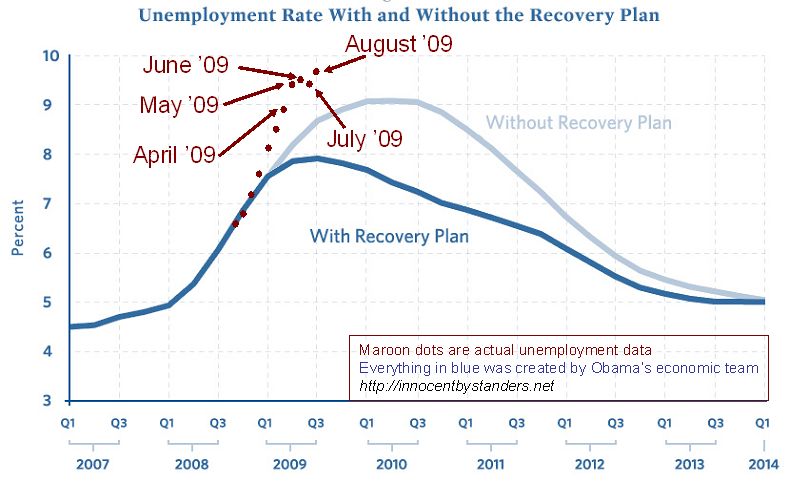
Pale blue is what was expected without the stimulus plan.
Darker blue is what was expected with the stimulus plan.
Maroon is actual unemployment as reported monthly by the Bureau of Labor Statistics.
I found the graphic here.
Friday, August 28, 2009
Obameter #5: the Earned Income Tax Credit
The Earned Income Tax Credit is a complicated, rather obscure aspect of tax law that generally tries to reward low-wage workers or workers facing unusual challenges for being productive members of the workforce to the tune of several thousand dollars each. Wikipedia estimates the total cost at something like $36 billion (in 2004). It's pretty complicated, though, with various fade-ins and fade-outs for taxpayers meeting various criteria. One of the unintended consequences of the EITC is the so-called "marriage penalty" wherein two single people filing taxes separately will pay less in taxes than if they marry and file jointly. This is because being an unmarried worker was once considered a hardship, so they increased the EITC for single people.
During his campaign, Obama made a three-part promise relating to the EITC:
I've addressed tax credits before, concluding that "With a tax credit, you're paying less money because you're conforming to more governmental rules." I remain wary of tax credits as a way for government to buy obedience from us taxpayers but, just as before, it's hard to criticize government for creating an incentive to work. Maybe it's a little easier now, since it's the second tax credit doing that exact same thing.
One risk of government paying low-wage workers to work is that it makes low-wage work seem better than it is. It's better than paying people to quit, as a badly designed unemployment program potentially could, but I continue to favor tax rate changes rather than rules and regulations regarding how you live your life. How much simpler it would be if all these eligibility programs with their complicated qualifications and dependencies were replaced with a negative income tax rate on the lowest tax bracket! But government continues to favor complicated systems of eligibility as though more laws means better laws.
And for them it does. Job security for Washington insiders, IRS agents, private accountants, and other experts on the unnecessary complication legislators create. They promise to simplify the tax code to get elected, but it keeps getting more complicated. Plus, again, they're buying your obedience. There's something creepily authoritarian about that.
 Given the ugly, complicated system Obama inherited, though, he did act to simplify it by removing the marriage penalty. I suppose that deserves my tentative, cautious approval. But this is the last government-paying-people-to-work tax credit that I'll be supporting. Employers are supposed to do that, not government.
A little reminder: every pixel on that dollar bill graphic stands for $150 million dollars -- about 40 times as much as the average American makes over the course of an 80 year career.
During his campaign, Obama made a three-part promise relating to the EITC:
- To remove the marriage penalty.
- To expand the credit for taxpayers with more than 3 children.
- To expand the credit for taxpayers without children.
I've addressed tax credits before, concluding that "With a tax credit, you're paying less money because you're conforming to more governmental rules." I remain wary of tax credits as a way for government to buy obedience from us taxpayers but, just as before, it's hard to criticize government for creating an incentive to work. Maybe it's a little easier now, since it's the second tax credit doing that exact same thing.
One risk of government paying low-wage workers to work is that it makes low-wage work seem better than it is. It's better than paying people to quit, as a badly designed unemployment program potentially could, but I continue to favor tax rate changes rather than rules and regulations regarding how you live your life. How much simpler it would be if all these eligibility programs with their complicated qualifications and dependencies were replaced with a negative income tax rate on the lowest tax bracket! But government continues to favor complicated systems of eligibility as though more laws means better laws.
And for them it does. Job security for Washington insiders, IRS agents, private accountants, and other experts on the unnecessary complication legislators create. They promise to simplify the tax code to get elected, but it keeps getting more complicated. Plus, again, they're buying your obedience. There's something creepily authoritarian about that.
$3,600b 2009 Federal Budget
Previously discussed wasteful spending
Previously discussed worthwhile spending
Earned Income Tax Credit (total cost)
A little reminder: every pixel on that dollar bill graphic stands for $150 million dollars -- about 40 times as much as the average American makes over the course of an 80 year career.
Subscribe to:
Posts (Atom)