Showing posts with label economics. Show all posts
Showing posts with label economics. Show all posts
Sunday, November 1, 2009
Economists on Jeopardy
How'd you do? I knew them all, though I couldn't think of the second one's name until they said it.

Saturday, October 3, 2009
Is the Health Care Overhaul Constitutional?
Even FactCheck.org was unable to answer that question definitively. I obviously oppose the health care reforms being considered.
The FactCheck.org analysis makes both sides of the issue sound pretty rational and reasonable, with one major exception:
Money is material security. Economics is how people attain material security. Purely economic liberty empowers one to protect one's own personal and bodily integrity. To impose upon economics liberties is a little push toward naked, homeless starvation. You cannot separate economic and personal liberties. Like energy and matter, they are phases of the same thing.
How is health insurance more directly related to personal, bodily integrity than cash money? The major difference I see is the difference between cash money and a food stamps or gift cards: one can be used for anything, while the other is limited. Also, food stamps and health insurance cost radically more to oversee and implement, so you get less out of it than you put into it. The generalized, low-cost version works better.
I'm absolutely convinced that forcing people to be consumers to a particular industry is wrong. I'm strongly confident (though not absolutely) it should be unconstitutional, but I'm a little doubtful that it actually will be declared unconstitutional. I far prefer it simply lose out in Congress, preventing it from consideration in the Supreme Court. But maybe I'm wrong. Maybe it'd be better for it to be considered by SCOTUS while it has this kind of chance of being declared unconstitutional rather than in some socialist future where opposition to centralized economic control has collapsed.
Save us from government's good intentions!
The FactCheck.org analysis makes both sides of the issue sound pretty rational and reasonable, with one major exception:
Mark Hall, professor of law and public health at Wake Forest University’s law school, writes that there is no fundamental right to be uninsured. "The liberty in question is purely economic and has none of the strong elements of personal or bodily integrity that invoke constitutional protection," he says.The sentence in bold is terribly ominous. It is horrifying to me that the right to property ("purely economic" liberty) is considered so easily divisible from the right to life ("personal or bodily integrity"). Bodily integrity is protected, day by day, by such material goods as clothes, shelter, seat belts, etc. These things are in turn provided by money, a purely economic entity. The core purpose of money is that we cannot possibly know every material good we may need in the future, so we have a general, all-purpose good that can be exchanged for whatever object fills whatever needs may arise.
Money is material security. Economics is how people attain material security. Purely economic liberty empowers one to protect one's own personal and bodily integrity. To impose upon economics liberties is a little push toward naked, homeless starvation. You cannot separate economic and personal liberties. Like energy and matter, they are phases of the same thing.
How is health insurance more directly related to personal, bodily integrity than cash money? The major difference I see is the difference between cash money and a food stamps or gift cards: one can be used for anything, while the other is limited. Also, food stamps and health insurance cost radically more to oversee and implement, so you get less out of it than you put into it. The generalized, low-cost version works better.
I'm absolutely convinced that forcing people to be consumers to a particular industry is wrong. I'm strongly confident (though not absolutely) it should be unconstitutional, but I'm a little doubtful that it actually will be declared unconstitutional. I far prefer it simply lose out in Congress, preventing it from consideration in the Supreme Court. But maybe I'm wrong. Maybe it'd be better for it to be considered by SCOTUS while it has this kind of chance of being declared unconstitutional rather than in some socialist future where opposition to centralized economic control has collapsed.
Save us from government's good intentions!
Tuesday, September 29, 2009
Absolute Writer's Block Found Something
Here's a comment on high-end health plans ("Cadillac health plans"), taxes, and the economy generally. It's pretty interesting.
Monday, September 7, 2009
Is The Stimulus Working?
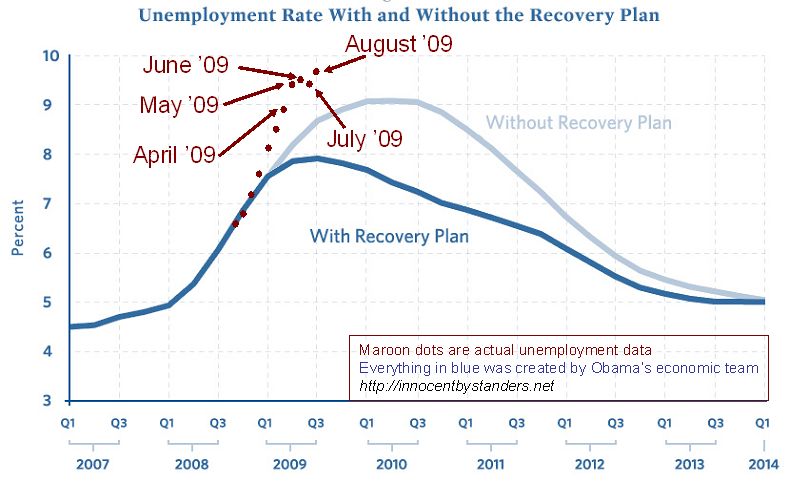
Pale blue is what was expected without the stimulus plan.
Darker blue is what was expected with the stimulus plan.
Maroon is actual unemployment as reported monthly by the Bureau of Labor Statistics.
I found the graphic here.
Monday, August 17, 2009
Obameter #32: Making Work Pay
When Obama said he was offering a tax cut to 95% of American families, this is the program he had in mind: the Making Work Pay tax credit. According to a recent CBS editorial, 43.4% of the population pays zero (or less) in taxes. This exposes a mild deceptiveness to the idea of a "tax cut" for 95% of people, but it's a negligible complaint. In the sludgy pool of ineffective welfare ideas, paying people to work is one of the better ones.
The way Making Work Pay works is that the government pays you 6.2% of what you earn until you've earned $8,100. 6.2% of $8,100 is about $500. The House of Representatives proposed a bill that matched Obama's plans, but the Senate was worried about the cost of the bill and cut it down to a maximum of $400 per person. Obama signed it into law on 17 Feb. 2009. PolitiFact calls it a compromise, and such it is.
There is a fine distinction between a tax cut and a tax credit that this analysis ignores. A standard tax cut involves lowering the percentage of your income you're paying to the government; for example, dropping the tax rate on the first $8,350 from 10% (where it currently is) to, say, 3.8% would be a tax cut. A typical tax credit reduces your taxes by some specific dollar amount for doing something the government likes at an income level the government approves. For example, the US child tax credit program gives a $1,000 tax credit per child to families making under some specific income threshold (it's a complicated math equation to determine the exact threshold).
It is often mistakenly said that a tax cut can never produce a debt from the government to the taxpayer while a tax credit can. An obvious example of a tax credit creating a government payout to a "taxpayer" is a single parent making $8,100 a year. The tax rate declares that they owe $810 in taxes, but the child tax credit ensures at least a $1,000 credit from the government. The "taxpayer" in this case is making at least $190 from the government. However, a negative tax rate would produce a welfare program, too, and has been recommended by such great Republican capitalists as Milton Friedman. There is not really a distinction between tax cuts and tax credits on that point.
The real distinction is why you're paying fewer taxes. In a tax rate cut, you're paying less in taxes because the government is simply taking less money. With a tax credit, you're paying less money because you're conforming to more governmental rules. The former is an increase of freedom, whereas the latter is not. Usually the rules aren't very controversial things (having children, being gainfully employed, starting a small business, etc), but the government programs are potentially paying people for things that are not necessarily helping anyone be better off. The classic criticism along this line is the example of a welfare mom, a hypothetical woman who refuses to marry and has another kid whenever her budget doesn't quite stretch far enough. Not every taxpayer is delighted with the idea of their money being used to motivate single mothers to get pregnant again.
 But how does this relate to Obama's MWP program specifically? After all, he's merely paying people a little to be gainfully employed. The final price tag on the program was $116.2 billion, which is about 3 cents on the dollar of Obama's budget for the year. The worst abuse of the system I can imagine is someone making exactly $6,451 a year in order to maximize the benefit from MWP. I don't expect the program to be hugely effective, but I've seen no way in which it's a horrible idea or open to severe abuses. If the Obama Administration would call it a tax credit and a welfare program, I'd have no criticism of it at all.
The way Making Work Pay works is that the government pays you 6.2% of what you earn until you've earned $8,100. 6.2% of $8,100 is about $500. The House of Representatives proposed a bill that matched Obama's plans, but the Senate was worried about the cost of the bill and cut it down to a maximum of $400 per person. Obama signed it into law on 17 Feb. 2009. PolitiFact calls it a compromise, and such it is.
There is a fine distinction between a tax cut and a tax credit that this analysis ignores. A standard tax cut involves lowering the percentage of your income you're paying to the government; for example, dropping the tax rate on the first $8,350 from 10% (where it currently is) to, say, 3.8% would be a tax cut. A typical tax credit reduces your taxes by some specific dollar amount for doing something the government likes at an income level the government approves. For example, the US child tax credit program gives a $1,000 tax credit per child to families making under some specific income threshold (it's a complicated math equation to determine the exact threshold).
It is often mistakenly said that a tax cut can never produce a debt from the government to the taxpayer while a tax credit can. An obvious example of a tax credit creating a government payout to a "taxpayer" is a single parent making $8,100 a year. The tax rate declares that they owe $810 in taxes, but the child tax credit ensures at least a $1,000 credit from the government. The "taxpayer" in this case is making at least $190 from the government. However, a negative tax rate would produce a welfare program, too, and has been recommended by such great Republican capitalists as Milton Friedman. There is not really a distinction between tax cuts and tax credits on that point.
The real distinction is why you're paying fewer taxes. In a tax rate cut, you're paying less in taxes because the government is simply taking less money. With a tax credit, you're paying less money because you're conforming to more governmental rules. The former is an increase of freedom, whereas the latter is not. Usually the rules aren't very controversial things (having children, being gainfully employed, starting a small business, etc), but the government programs are potentially paying people for things that are not necessarily helping anyone be better off. The classic criticism along this line is the example of a welfare mom, a hypothetical woman who refuses to marry and has another kid whenever her budget doesn't quite stretch far enough. Not every taxpayer is delighted with the idea of their money being used to motivate single mothers to get pregnant again.
$3,600b 2009 Federal Budget
Previously discussed wasteful spending
Making Work Pay tax credit program
Subscribe to:
Posts (Atom)